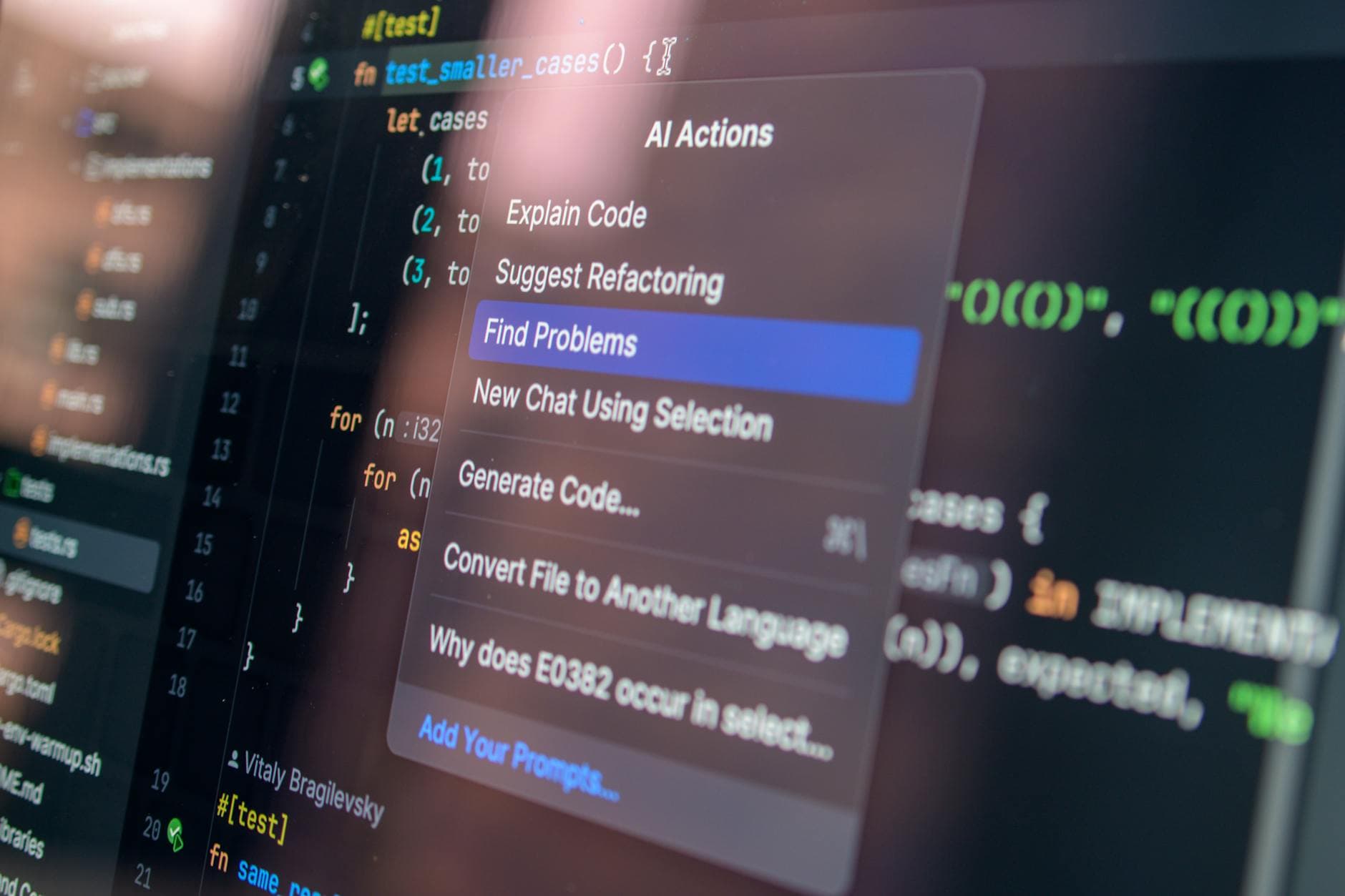

The AI tools landscape in 2026 is no longer experimental — it is operational. IT companies that have integrated AI into their workflows report 30–50% improvements in developer throughput, 40% reduction in first-draft content time, and measurable improvements in client delivery speed. The question is no longer "should we use AI?" but "which tools for which workflows, and how do we build the discipline to use them consistently?" This guide is organized by company type and use case — because the right stack for a 15-person IT agency looks very different from the right stack for a product startup building its own SaaS.
Coding & Development Tools
For coding and development, the tools that have genuinely moved the needle are Claude (Anthropic), GitHub Copilot, and Cursor IDE. Claude is the benchmark for complex reasoning tasks — architecture decisions, code review, debugging gnarly logic, writing test suites, and explaining legacy codebases to new team members. GitHub Copilot integrates directly into VS Code and JetBrains, providing inline completions and multi-line suggestions that meaningfully accelerate boilerplate-heavy work. Cursor is an AI-native IDE built on VS Code that provides deeper context awareness across the entire codebase — it can understand file relationships, suggest refactors that span multiple files, and answer questions about your specific codebase rather than generic programming concepts. For IT agencies writing code for clients, these three together reduce junior developer ramp time by 40–60% and improve senior developer output by 25–35%.
Design & UI Tools
For design and UI work, Figma AI, Uizard, and Framer AI have changed what a small team can produce in a sprint. Figma's built-in AI features can auto-generate layouts from text descriptions, restyle components across a design system, and summarize feedback threads. Uizard lets non-designers create wireframes and mockups from rough sketches or text prompts — ideal for IT agencies that need to rapidly prototype client ideas before committing to full design. Framer AI can generate and publish full landing pages from a text prompt, which is genuinely useful for quick client demos or MVP landing pages. For product companies, Midjourney and DALL-E 3 remain the standard for generating custom illustration assets, hero images, and marketing visuals without a stock photo subscription.
Writing, Documentation & Content Tools
For writing, documentation, and content, the tools that IT companies actually use in production are Claude, ChatGPT (GPT-4o), Notion AI, and Grammarly Business. Claude handles long-form content particularly well — proposals, case studies, technical documentation, blog posts, client reports — with a writing style that is less robotic than older GPT outputs. Notion AI is integrated directly into Notion workspaces and handles meeting summary generation, action item extraction, and document drafting without switching tools. Grammarly Business integrates across email, Slack, Google Docs, and the browser to catch not just grammar errors but tone mismatches — particularly useful for client-facing communication from non-native English speakers.
Sales, CRM & Business Development Tools
For sales, CRM, and business development, Clay, Apollo.io, and HubSpot with AI features have become the standard stack for IT companies building outbound pipelines. Clay is a data enrichment and outreach automation tool that pulls prospect data from 50+ sources and uses AI to write personalized outreach messages at scale — reducing the manual research time per prospect from 20 minutes to under 2 minutes. Apollo.io provides lead database access, email sequencing, and AI-powered email writing. HubSpot's AI features include conversation intelligence — recording and summarizing sales calls, identifying objections, and recommending follow-up actions. Also worth noting: Pipedrive with its AI Sales Assistant is a leaner alternative for smaller teams.
Customer Support & Client Communication Tools
For customer support and client communication, Intercom Fin, Zendesk AI, and Freshdesk Freddy AI are the most deployed among IT companies with product businesses or high-volume client queries. Intercom's Fin is an AI agent that handles Tier 1 support queries by drawing from your help documentation — it resolves 40–60% of incoming tickets without human intervention. This is transformative for product companies that cannot afford a large support team in the early stages. Freshdesk with Freddy AI offers a more affordable entry point for smaller teams, with AI-powered ticket routing, suggested responses, and CSAT prediction built in.
Meeting, Knowledge & Internal Ops Tools
For meetings, documentation, and internal knowledge, Otter.ai, Fireflies.ai, and Loom AI have become standard. Otter.ai transcribes meetings in real time, generates summaries, and identifies action items — integrating with Google Meet, Zoom, and Microsoft Teams. Fireflies.ai does the same with better search and analytics features across a larger call history. Loom AI automatically generates titles, summaries, and chapters for recorded video updates — useful for async communication in distributed teams and for creating client walkthrough videos. For knowledge management, Notion AI and Confluence AI help teams find information faster and generate documentation drafts from existing content.
Marketing, SEO & Social Content Tools
For marketing, SEO, and social content, the tools that deliver ROI for IT companies are Jasper, Copy.ai, Semrush AI, and Canva Magic Studio. Jasper and Copy.ai are AI writing tools optimized for marketing copy — landing pages, email sequences, LinkedIn posts, ad copy. Semrush's AI Writing Assistant provides SEO-optimized content suggestions and topic briefs, particularly valuable for IT companies investing in content marketing. Canva Magic Studio enables non-designers to produce professional visual content consistently. For IT agencies managing client social media, Buffer AI and Later help plan and schedule content at scale.
Data Analysis & Reporting Tools
For data analysis, reporting, and business intelligence, Microsoft Copilot for Excel, Google Gemini in Sheets, and Tableau AI are the tools IT founders are using to reduce time spent on financial reporting and data analysis. Microsoft Copilot can write complex Excel formulas from natural language, generate pivot tables and charts from described requirements, and summarize large datasets. For product companies with user analytics data, Mixpanel AI and Amplitude's AI features surface insights and anomalies automatically rather than requiring manual dashboard monitoring.
The Most Important Thing: Workflow Discipline
The most important thing about building an AI tools stack is not the tools themselves — it is the workflow integration discipline. The IT companies getting the most value from AI have done three things: they have identified the specific repetitive, time-consuming tasks in their workflow (first drafts, meeting summaries, boilerplate code, proposal writing, status reports), they have assigned specific tools to specific workflows rather than letting everyone experiment with everything, and they have built internal documentation and training so the entire team uses the tools consistently.
A company where five developers each use AI differently gets fragmented benefits. A company where the team has a shared playbook — "Cursor for development, Claude for proposals and documentation, Otter for meeting notes, Clay for prospecting" — gets compounding efficiency gains. The tool selection matters. The workflow discipline matters more.
"The IT companies getting the most value from AI have not just adopted tools — they have built workflow discipline. A shared playbook beats individual experimentation every time."
— SIC Editorial, Surat IT Community