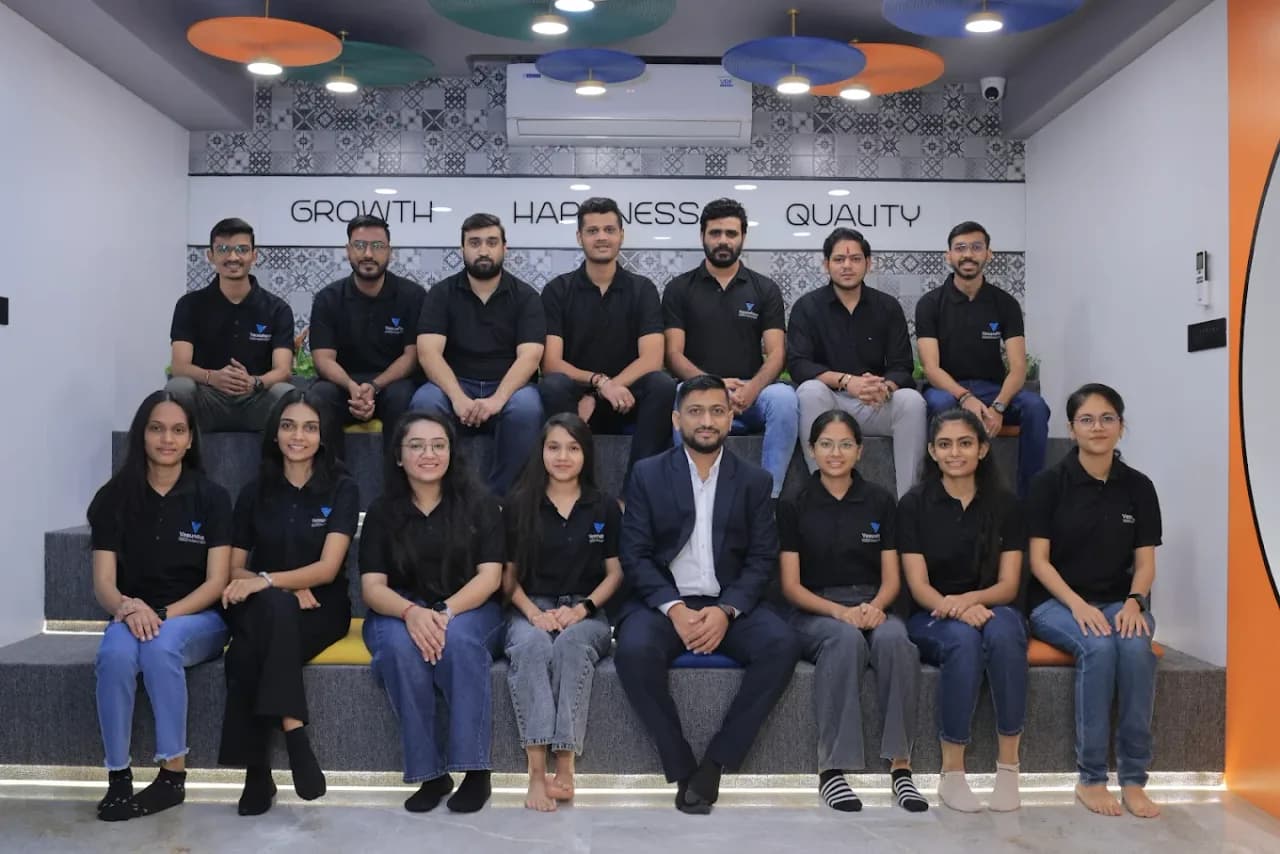
When Vasundhara Infotech crossed 10 employees in 2019, I thought the hard part was over. We had survived the scrappy early years — the 18-hour days, the clients who paid late, the months where payroll was a prayer. We had built a real team. Surely the growth phase would be easier.
I was wrong. The journey from 10 to 100 was harder, more humbling, and ultimately more rewarding than anything we had done before. The skills that made us a good 10-person company actively worked against us as we tried to become a 50-person company. And the skills that made us a good 50-person company required us to completely rethink what made us good at 100.
This is not a feel-good story about hypergrowth. It is an honest account of the mistakes we made, the systems we built in response, and the specific decisions that I believe made the difference between sustainable scale and the chaotic growth I watched destroy other companies around us.
The Culture Dilution Problem Nobody Warns You About
The first challenge that blindsided me was culture dilution — and I have never met a founder at 10 people who genuinely expects it.
When you are 10 people, culture is automatic. Everyone eats lunch together. Everyone knows each other's families. The values of the company are essentially the values of the founding team, transmitted by proximity and shared experience. When someone does something that doesn't fit the culture, everyone notices immediately. Correction is immediate and natural.
Then you hire 20 more people. Then 20 more. The people you hired in batch 2 learned the culture from the people in batch 1 — but with some degradation, the way a photocopy of a photocopy loses resolution. By batch 3, you have new employees who have never had a conversation with a founder. Their understanding of "how we do things here" comes entirely from their immediate team lead — who may or may not embody the culture you intended.
We discovered this problem when we started hearing about internal conflicts that sounded completely foreign to us. Teams were communicating less. People were optimising for their own metrics instead of helping adjacent teams. The collaborative energy that had defined our early years was being replaced by something that felt more like a collection of individuals working in the same building.
What we did about it: We started writing things down — not just processes, but values. Not just "we are customer-centric" as an abstract phrase, but specific stories of times we did the right thing when it was hard. The story of the client delivery we stayed up three nights to fix because it was the right thing to do. The story of the employee we promoted two years early because he was clearly ready, even though it was inconvenient for the team's hierarchy. These stories became part of onboarding. Every new hire heard them on day one. We also started quarterly all-hands where anyone could ask any question — and we answered everything honestly, including the hard questions about where we were struggling.
Culture maintenance at scale is not a passive activity. It requires intentional investment of founder time, stories that make values concrete, and rituals that remind the team why they are there.
Hiring Discipline: The Rule We Broke and the Rule We Kept
The hiring mistake that cost us the most time, money, and morale was the desperation hire. Every time — without exception — that we hired someone primarily because we were desperate rather than because they were right for the role, we regretted it within 90 days.
The math is brutal at scale. A mediocre hire at 10 people slows down 1–2 other people. A mediocre hire at 30 people, on a cross-functional team, can slow down 5–8 people. A mediocre hire in a lead role at 50 people can poison an entire department for 6 months while you manage the performance issue that everyone else on the team has already identified except you.
We made a rule: no hire made out of deadline pressure. If a client project required 3 more engineers and we could not find 3 good engineers in time, we negotiated the deadline — not the quality bar. We said no to growth on two occasions because we could not staff it the right way. Both times, the right candidates appeared within 60 days. Both times, the clients respected us more for being honest about our capacity.
The hiring practice that saved us the most time: structured interviews with written evaluation criteria. Every interviewer knew exactly what they were evaluating — not just "is this person good?" but "does this person demonstrate initiative when facing ambiguous requirements?" with a 1–5 scale and examples of what each score looks like. Calibrated hiring reduces disagreement, speeds decisions, and makes it possible to give candidates honest, useful feedback even in rejection.
We also committed to a 90-day rule: if a new hire is clearly the wrong fit within 90 days, act immediately. The kindest thing you can do for a person who is wrong for a role is to have an honest conversation early, before they have invested more of their career and before the team has compensated for their gaps long enough that they expect it permanently.
Client Management When You Can No Longer Know Everyone
At 10 people, I knew every client personally. I knew their names, their business goals, their personal quirks. I knew which clients wanted detailed status updates and which ones trusted us to just get it done. I was the relationship — not just its steward.
At 50 people, I could not be the relationship for every client. We had 40+ active engagements. The transition from "founder as relationship" to "team as relationship" is one of the most dangerous periods in a growing IT company. If you do not build the systems to transfer client trust to your team before you need them, you find out they are missing at the worst possible moment — usually when a client notices something is wrong and cannot reach the person they trust.
The three systems that protected our client relationships during growth:
First, quarterly business reviews (QBRs). Every client with a contract over ₹20 lakh per year got a structured quarterly call with their account manager and me. The agenda was consistent: what we delivered, what's coming, what we're seeing in their industry, and what could be better. QBRs gave clients a predictable window into the relationship and removed the anxiety of "are they thinking about us?"
Second, dedicated account managers with real authority. Account managers at Vasundhara can approve scope changes, expedite support tickets, and offer a 10% discount without founder approval. They need to be empowered to solve problems without escalating everything. If every client issue goes to the founder, you have not delegated — you have renamed the problem.
Third, a no-surprise policy. Bad news travels fast or it gets worse. If a delivery is going to be late, the account manager calls the client before the deadline, not after. If scope is creeping beyond estimate, we flag it before it becomes a dispute. Clients have consistently told us that our willingness to surface problems early is one of the main reasons they stay with us — they know we will not hide things from them.
The Process Playbook: Systems That Scaled
Growing from 10 to 100 people requires building institutional memory — the ability to do things the right way even when the people who invented the right way are not in the room.
The process investments that paid the highest returns at Vasundhara:
A single project management platform, enforced. We tried having teams use their preferred tool. The result was 4 different tools, no visibility across teams, and project handoffs that required 3 meetings to establish context that should have been visible in 30 seconds. We mandated one tool, trained everyone on it, and made the expectation clear: if it is not in the PM tool, it does not exist. The adoption fight lasted 3 weeks. The benefit has compounded for 5 years.
Weekly all-hands, 15 minutes maximum. Every Monday, 9:15 AM. Company numbers from last week, one thing each department is focused on this week, one thing the founders want to communicate. No presentations. No PowerPoint. Fifteen minutes and done. The ritual keeps everyone connected to the broader company without consuming the time that should go to actual work.
Written decision logs. For any significant decision — a new technology adoption, a pricing change, a new service offering — we write down the context, the options considered, and the reasoning behind the choice. This sounds bureaucratic. In practice, it eliminates the "why did we decide to do it this way?" conversation that wastes hours in growing companies. New team leads can read 6 months of decision logs and understand the company's thinking without interviewing everyone who was in the original meeting.
Postmortems on every major failure. Not witch hunts — structured analyses of what went wrong, what we could have caught earlier, and what we are changing as a result. The postmortem format is simple: timeline of events, root cause (not blame), corrective actions with owners and deadlines. We have run postmortems on missed deadlines, lost clients, and employee departures. Every postmortem has made us better.
The Metrics That Tell You If Scaling Is Actually Working
A company can grow headcount while getting worse. Revenue can increase while margins collapse. Clients can multiply while client satisfaction falls. The vanity metrics of growth — headcount, revenue, client count — tell you if you are getting bigger. The operational metrics tell you if you are getting better.
The six metrics we track at every leadership meeting:
- Revenue per employee — Our target is ₹18–22 lakh per employee per year. Below ₹15 lakh means we are overstaffed relative to revenue or underpriced. This single metric has prevented us from hiring our way into an unscalable cost structure.
- Client Net Promoter Score (NPS) — Surveyed quarterly. Not "are you satisfied?" but "on a scale of 1–10, how likely are you to recommend us to a peer?" Below 7 triggers an account review within 2 weeks.
- Employee 6-month retention — The percentage of hires who are still with us at 6 months. Below 80% means our onboarding or hiring process is broken. Above 90% is our target.
- Time-to-hire for senior roles — If this number is increasing, it means our talent pipeline is thin or our hiring bar is inconsistently applied. We target under 45 days from job posting to offer acceptance for senior roles.
- Gross margin by service line — Not all revenue is equal. A client engagement that requires heavy senior developer time for ₹30 lakh may generate lower margin than a ₹20 lakh retainer with junior-heavy execution. We track margin by service line quarterly and reallocate resources accordingly.
- Support ticket resolution time — Our commitment to clients is 4-hour response for P1 issues, 24-hour resolution target. When this number slips, it is usually the first visible signal of team overextension before it shows up in client NPS.
What I Would Tell My 10-Person Self
If I could go back to 2019 and brief myself before the growth phase, here is what I would say:
Build your systems before you need them, not after you break without them. Every system we built reactively — in response to a crisis — cost 3x more to implement under pressure than it would have cost to build proactively. The process playbook, the account management structure, the hiring criteria — all of these would have been cheaper, faster, and better implemented during a calm period rather than during the emergency that made them obviously necessary.
Protect your senior people from operational chaos. Your best engineers, your best project managers, your best account managers — they will leave if they spend more than 20% of their time on operational friction that should be solved by better systems or by support staff. The first hire to make when you are scaling is not another developer. It is the person who removes operational friction from everyone else.
Salary is necessary but not sufficient for retention. We lost three excellent people to companies paying 15–20% more before we understood that they were not leaving for money — they were leaving for growth, for ownership, and for the feeling that their work was building something meaningful. Compensation must be fair. But the engineers and managers you most want to keep are the ones for whom compensation is not the primary decision driver. Invest in the non-salary factors — meaningful work, growth paths, autonomy — and your retention numbers will outperform companies paying more than you.
Your job changes completely at every order of magnitude. The founder job at 10 people is a doing job. The founder job at 50 people is a managing job. The founder job at 100 people is a communicating and culture job. Many founders fail the transition from doing to managing, and more fail the transition from managing to leading. Each transition requires letting go of something that made you effective at the previous stage. The doing founder who cannot let go of delivery will become the bottleneck at 50 people. The managing founder who cannot let go of operational decisions will become the bottleneck at 100. Know which transition you are in, and actively work to become the founder the next stage requires.
Today Vasundhara Infotech has 150+ team members across Surat and a client base spanning North America, Europe, and Southeast Asia. The playbook still works. If you are at 10 people and thinking about scale, the single most valuable thing you can do is start building your systems now — not as overhead, but as the foundation that will determine whether your growth is sustainable or chaotic.
"The cost of a bad hire at 30 people is much higher than at 10. Every mediocre hire slows down three other people, not just one."
— Chirag Pipaliya, CEO, Vasundhara Infotech